 New Orleans Ghost Tours
LaLaurie Mansion: The History, the Legend and How to Visit
The LaLaurie Mansion at 1140 Royal Street is the most talked-about address in the French Quarter. In 1834 a fire in the kitchen exposed the treatment of the enslaved people its owner, Delphine LaLaurie, held in the attic, and the story has grown darker with every retelling since. This page separates the documented record from the legend that later books and television added. It also answers the practical question most visitors arrive with: you can look at the house from the street, and that is all. Several French Quarter ghost walks stop at its corner and tell the story where it happened. Every other stop in the city is on the haunted places in New Orleans page. The bookable tours are compared on ghost tours in New Orleans.
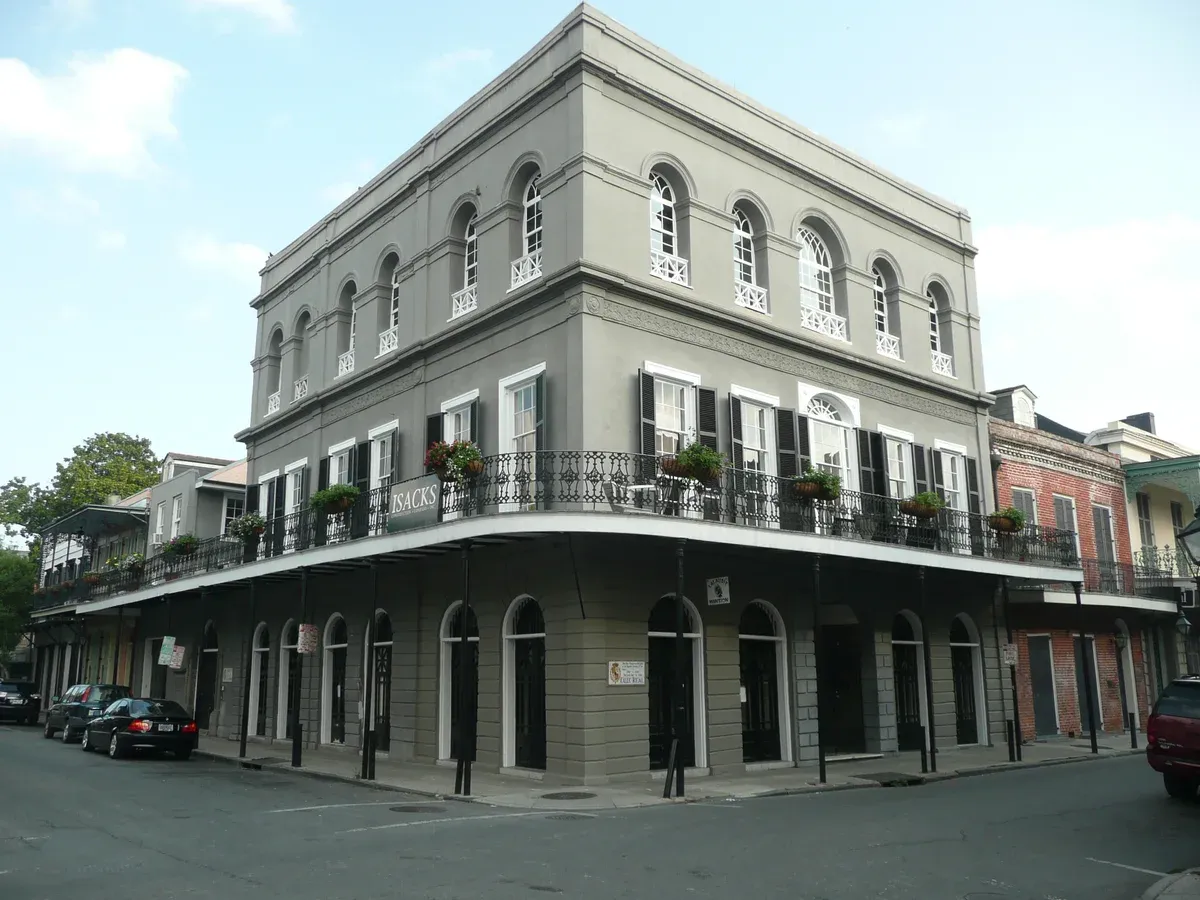
The LaLaurie Mansion at the corner of Royal and Governor Nicholls, a private residence. Photo: Reading Tom, CC BY 2.0, via Wikimedia Commons
Quick answer The short answer
The LaLaurie Mansion is a private mansion at 1140 Royal Street in the French Quarter, famous for the 1834 fire, when rescuers found bound and mutilated enslaved people in the attic of its owner, Delphine LaLaurie. It is not open to the public. You can see it only from the street, at the corner of Governor Nicholls Street. Several guided ghost walks stop outside it and tell the story.
Key takeaways
- The French Quarter ghost, voodoo and vampire walking tour stops at the LaLaurie Mansion for $33 and lasts 1.5 to 2 hours.
- The family-friendly French Quarter ghost tour also lists the mansion on its route for $29 over 1.5 hours.
- The newspapers of 1834 reported seven victims. The cage and limb stories came from later books.
- Know before you go: the house is a private residence and can be seen only from the street.
- For the wider map of free stops, see haunted places in New Orleans.
The LaLaurie Mansion: What the Record Shows
The documented story is grim enough without the embellishments. Here is what primary sources and the press of the day actually recorded.
The House and the Household
Delphine LaLaurie bought the property at what is now 1140 Royal Street in 1831. The two-story mansion, with attached slave quarters behind it, was finished in 1832. She lived there with her third husband, Dr. Leonard Louis Nicolas LaLaurie, whom sources date to either 1825 or 1828 as the marriage year. The corner street beside the house, today Governor Nicholls Street, was then called Hospital Street.
The household's cruelty was already on record before the fire. In 1833 Harriet Martineau reported that LaLaurie and her household were found guilty of mistreating enslaved people and forfeited nine of them, who were then bought back through an intermediary relative. Twelve deaths of enslaved people in the household are documented between 1830 and 1834. That figure matters, because modern retellings claim up to 100 deaths in the house, and the records do not support it.
The original mansion burned and what stands today is a rebuild, which is worth knowing when you look at it.
The Fire of 1834
A fire broke out in the kitchen of the mansion in 1834. A 70-year-old cook, chained to the stove, admitted setting the fire as a suicide attempt. Rescuers who entered the house found bound and mutilated enslaved people in the attic.
The New Orleans Bee reported finding seven people, more or less horribly mutilated, suspended by the neck. 64 Parishes describes the same discovery as seven bondspeople who had been starved, tortured and chained. Those seven are what the historical record supports. The cage stories, the limb stories and the count of 100 deaths were added in later retellings, some dating from the 1920s onward, and have no primary source behind them.
News of what the rescuers found spread through the city within hours. What happened next destroyed the LaLauries' position in New Orleans completely.
The Mob, the Ruin and the Flight
Up to 4,000 people are said to have viewed the victims after the fire. A mob then attacked the house and heavily damaged it. The property stood ruined for four years until Charles Caffin bought it in 1838 and had it rebuilt in the Empire style by Pierre Trastour. That rebuild is the three-story building you see today, its facade baroque with iron grillwork on the balconies. A 1928 description called it the highest building for squares around, and a third floor and a rear building on Governor Nicholls Street were added during the 19th century, the rear one remodelled in the 1970s by the architects Koch and Wilson.
Delphine LaLaurie never faced justice. She fled by schooner to Mobile, Alabama, and then on to Paris, where 64 Parishes says she had settled by 1835. She escaped to France with her family and was never brought back.
| Year | What happened |
|---|---|
| 1831 | Delphine LaLaurie buys the property on Royal Street |
| 1832 | The two-story mansion with attached slave quarters is finished |
| 1833 | A cruelty case is reported by Harriet Martineau, with nine enslaved people forfeited and bought back |
| 1834 | Kitchen fire. Rescuers find seven bound and mutilated enslaved people in the attic, as the New Orleans Bee reported |
| 1834 | A mob of up to 4,000 onlookers is said to have gathered and the house is heavily damaged |
| 1838 | Charles Caffin buys the ruined property and Pierre Trastour rebuilds it in the Empire style |
| 2007 | Nicolas Cage buys the house for $3.45 million |
| 2010 | Michael Whalen buys it for $2.1 million |
Sources: Wikipedia, LaLaurie Mansion, 64 Parishes, Legends of America
Who Was Delphine LaLaurie
Before the mansion, there was a Creole society woman with three marriages and a position near the top of New Orleans society.
Three Marriages and a Place in Society
Delphine LaLaurie was born Marie Delphine Maccarthy on 19 March 1787 in New Orleans. She married three times. Her first marriage, in 1800, was to Don Ramon de Lopez y Angulo. Her second, in 1808, was to the banker Jean Blanque. Her third was to Dr. Leonard Louis Nicolas LaLaurie, and here the sources differ. Wikipedia dates the marriage to 1825, while 64 Parishes says she married Louis Lalaurie in 1828. Both agree he was her third husband and a physician.
By the 1830s she held a place among the leading families of the city, which is part of why the events of 1834 caused such a shock. The cruelty case of 1833, reported by Harriet Martineau, had already put her household under scrutiny a year before the fire. She forfeited nine enslaved people in that case and they were bought back through a relative acting as intermediary, which let them return to her household.
Paris, the Copper Plate and the Grave
After the mob wrecked her house, Delphine LaLaurie fled by schooner to Mobile, Alabama, then on to Paris. She never returned to New Orleans and never faced a court. French archives record that she died in Paris on 7 December 1849.
Her burial has its own tangle. A copper plate found in St. Louis Cemetery No. 1 in the late 1930s by sexton Eugene Backes read that Madame Lalaurie, born Marie Delphine Maccarthy, died in Paris on 7 December 1842. That year is wrong, since French archives show 1849. 64 Parishes says her body was exhumed in 1851 and reinterred in St. Louis Cemetery No. 1 in New Orleans, having first been buried at Montmartre Cemetery.
The gruesome details repeated on ghost walks today, the cages and the mutilations beyond what the Bee printed, trace back to later retellings such as Jeanne DeLavigne's 1946 book, and they have no primary source behind them. The documented record holds seven victims found in 1834 and twelve documented deaths in the household between 1830 and 1834.
Sources: Wikipedia, Delphine LaLaurie, 64 Parishes
The Real Story of The Most Haunted House in New Orleans: Lalaurie's Mansion on Royal St
A local guide tells the LaLaurie story in front of the house on Royal Street. Third-party video by New Orleans Deep Tours. This site did not shoot it and has no relationship with the creator.
How the Legend Grew
The documented record is grim enough. Everything scarier that people repeat today was added later, mostly in the 20th century.
What the Record Actually Says
Strip the story back to what was written at the time and the picture is narrower than the tour versions. The New Orleans Bee reported seven people found, more or less horribly mutilated and suspended by the neck. A 70-year-old cook, chained to the stove, admitted setting the fire in a suicide attempt. Records show 12 documented deaths of enslaved people in the household between 1830 and 1834. That is the documented core. Anything beyond it comes from later retellings.
The exaggeration works the other way too. Modern retellings claim up to 100 deaths in the house, a figure with no paper trail at all. The gap between 12 documented deaths and a round claim of 100 is where most of the mansion's reputation was built. When you hear a guide give a body count, ask which end of that gap they are standing on.
The Stories With No Primary Source
The gruesome details people repeat today, the elaborate torture apparatus and the rest, trace back to retellings such as Jeanne DeLavigne's 1946 book, and they have no primary source behind them. Ghost City Tours dates the elaborated fictional accounts of Delphine LaLaurie to the 1920s onwards, long after she left New Orleans. In other words, the most lurid parts of the story grew up in books written for readers who wanted a scare, long after anyone who had seen the house in 1834 was gone.
None of this softens the documented facts. A woman whose household lost 12 enslaved people between 1830 and 1834 fled a city that had just read a newspaper account of seven mutilated people in her attic. The legend does not need inventing. It only needs the record, and the record is bad enough.
Claims Against the Record
This table compares the common LaLaurie claims with the sources behind them, drawn from Wikipedia, 64 Parishes and Legends of America. Read the middle column before you repeat the left column as fact.
| Claim | Where it comes from | What the record says |
|---|---|---|
| Up to 100 people died in the house | Modern retellings and many ghost tours | Historical records show 12 documented deaths of enslaved people in the household between 1830 and 1834. |
| Victims were found in cages with limbs removed | 20th century books and tour lore | The New Orleans Bee reported seven people, more or less horribly mutilated, suspended by the neck. The cage and limb details have no primary source. |
| Delphine LaLaurie died in Paris in 1842 | A copper plate found in St. Louis Cemetery No. 1 in the late 1930s by sexton Eugene Backes | French archives show she died on 7 December 1849, so the year on the plate is wrong. |
| She was buried in New Orleans | 64 Parishes | 64 Parishes says her body, first buried at Montmartre Cemetery, was exhumed in 1851 and reinterred in St. Louis Cemetery No. 1. |
| She fled and was never punished | Wikipedia and 64 Parishes | Documented. She escaped by schooner to Mobile, Alabama, then to Paris, settling there by 1835, and was never brought to justice. |
| She married three times | Wikipedia and 64 Parishes | Documented, though sources conflict on dates. Wikipedia gives Don Ramon de Lopez y Angulo in 1800, Jean Blanque in 1808 and Dr. Leonard Louis Nicolas LaLaurie in 1825. 64 Parishes dates the third marriage to 1828. |
Sources: Wikipedia, 64 Parishes
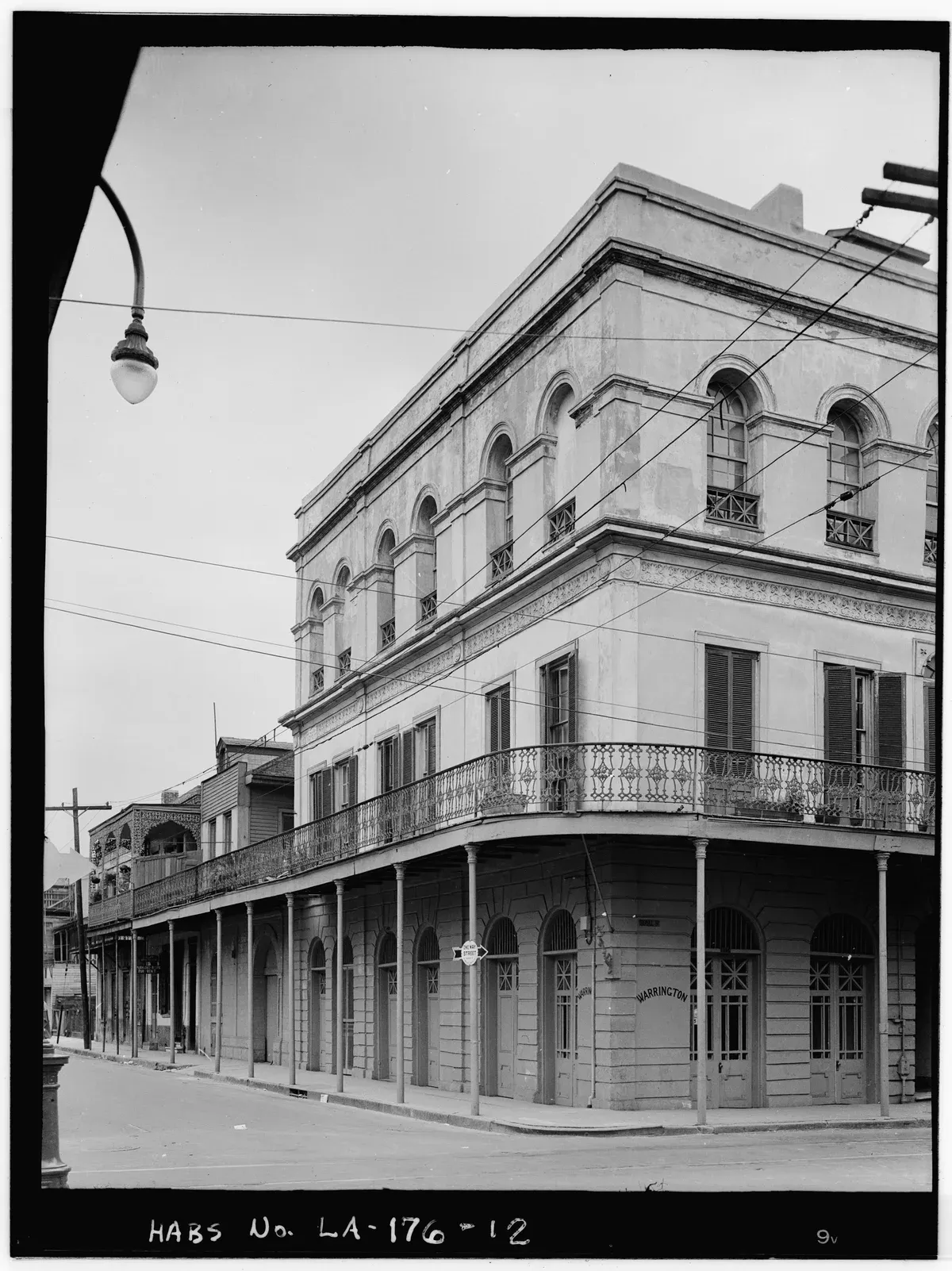
The house photographed for the Historic American Buildings Survey in 1937. Photo: Historic American Buildings Survey (Library of Congress), public domain, via Wikimedia Commons
The House After 1834: Owners and Uses
The mansion Delphine LaLaurie knew burned and was replaced. The building on Royal Street today is a rebuild from 1838 onwards.
Rebuilt in the Empire Style
After the 1834 fire the property stood ruined for four years. Charles Caffin bought it in 1838 and had it rebuilt in the Empire style by Pierre Trastour. A third floor and a rear building were added during the 19th century. The rear building on Governor Nicholls Street was remodelled in the 1970s by the architects Koch and Wilson.
So the facade you photograph is not the house of 1832. It is a three-story rebuild from 1838 onwards, described in 1928 as the highest building for squares around. The rebuilt facade is baroque with iron grillwork on the balconies, and the drawing rooms hold plaster rosettes, black marble mantelpieces and fluted pilasters. Behind the street door, which has iron grillwork and a carved panel, sit a black and white marble vestibule and a curved mahogany staircase running through all three stories. The second floor has three large drawing rooms joined by ornamented sliding doors. That description is on paper. You will see only the outside.
School, Refuge, Bar, Furniture Store
The house has had many uses since the fire. Later uses included a high school, a music conservatory, apartments, a youth refuge, a bar and a furniture store. Legends of America fills in dates: the house served as a school and later a tenement, then in 1923 became the Warrington House refuge for young delinquents, and in 1932 it was sold to the Grand Consistory of Louisiana, a Scottish Rite Masonic body.
The corner street was once called Hospital Street, which is worth remembering when old documents refer to the address. None of these later occupants turned the building into a museum.
Nicolas Cage and the Sales After 2007
Nicolas Cage bought the house in 2007 for $3.45 million and lost it to foreclosure in 2009. After the foreclosure Regions Financial Corporation bought the property for $2.3 million. Michael Whalen bought the house in 2010 for $2.1 million. Today the LaLaurie Mansion is a private residence.
What is documented about his ownership is the price, the years and the foreclosure.
American Horror Story: Coven
American Horror Story: Coven, the third season of the FX series, gave the house a heavily fictionalised portrayal with Kathy Bates as Madame LaLaurie. The season premiered on 9 October 2013, was set in New Orleans and filmed in the city from 23 July 2013 to 17 January 2014. Bates won a Primetime Emmy Award for the role. The show blended LaLaurie with elements of the Elizabeth Bathory legend, which is fiction, not history. In the premiere episode, titled Bitchcraft, her character is dug up alive by Fiona Goode.
Here is the fact most Coven pilgrims miss: the show did not film at 1140 Royal Street. Per Ghost City Tours, Coven shot its LaLaurie interiors at the Hermann-Grima House and its exteriors at the Gallier House, two doors from the real mansion. The Garden District's Buckner Mansion played Miss Robichaux's Academy. Coven earned seventeen Primetime Emmy nominations at the 66th ceremony, and Angela Bassett played Marie Laveau. So if you want to stand where the cameras rolled, you stand at the Gallier House, not at the LaLaurie.
Sources: Wikipedia, Legends of America, Ghost City Tours
Can You Go Inside the LaLaurie Mansion?
No. The short version, and the longer version of why people get this wrong.
It Is Someone's Home
The LaLaurie Mansion is a private residence, can only be seen from the street and is not open for visits or tours. Ghost City Tours says the same plainly: the mansion is privately owned and not open to the public. There is no ticket, no lobby, no hour you can walk through. Any tour that implies it will take you inside the LaLaurie Mansion is wrong before it starts. The one walk on this site that goes inside a building, the French Quarter ghost tour with interior visit, enters a different private haunted location, not the LaLaurie.
This surprises people who have seen the house on television, but it is the simple reality of the address. Its owners have never turned it into an attraction.
Where to Stand and How to Behave
Visitors can view the exterior from Royal Street at the corner of Governor Nicholls Street. That corner is the classic viewing spot, and the mansion fills it, rising three stories above the intersection. Remember the street was once called Hospital Street if you are matching old maps or documents. Stand on the sidewalk, look up at the iron grillwork and take your photos.
Then remember the most important rule: it is someone's home. It is a private residence. Keep your voice down, do not block the door or the sidewalk for long, do not peer into windows and do not knock. The house is free to see, which makes it one of the best value stops in the Quarter, and behaving well keeps it that way.
When to See It and What Is Nearby
You can see the exterior at any hour, and the mood changes with the light. Sunset in New Orleans falls at about 5:23 PM in January, 7:09 PM in March, 8:03 PM in June and 5:03 PM in December, so time your visit if you want the building in evening gloom. Several of the ghost walks pass the corner.
The block rewards the walk. The Gallier House at 1132 Royal Street, built from 1857 to 1860 by architect James Gallier Jr., sits two doors down and was the Coven exterior. The Beauregard-Keyes House at 1113 Chartres Street, built in 1826, is nearby and now operates as the BK Historic House and Gardens. Both belong to the wider list of haunted places in New Orleans, which covers everything in the Quarter you can see without a ticket. If you want to sleep near the stories instead, that is a different list of haunted hotels in New Orleans.
Sources: Legends of America, Ghost City Tours
Ghost Tours That Stop at the LaLaurie Mansion
Five of the walks compared on this site name the LaLaurie Mansion on their route. All prices are the booking platform listing prices.
Which Walks Pass the Corner
The LaLaurie Mansion is on the route of five tours in this comparison, all French Quarter walking tours. Every one of them views the house from outside, because there is nothing else to do with a private residence. The interior visit in the Tour Orleans walk is a different private building. Check start times on the booking page.
The table compares the five by price, length and meeting point. The cheapest at $21 and the family option at $29 both pass the corner, as does the pick of the French Quarter walks at $33.
| Tour | Price | Length | Meets at |
|---|---|---|---|
| Ghost and Vampire Walking Tour of the French Quarter | $21 | 2 hours | The Voodoo Lounge, 718 N Rampart Street, arrive at least 10 minutes early |
| Dark Side of New Orleans: French Quarter Ghost Tour | $29 | 1.5 hours | St. Louis Cathedral, 615 Pere Antoine Alley |
| New Orleans Haunted Ghost, Voodoo and Vampire French Quarter Walking Tour | $33 | 1.5 - 2 hours | Witches Brew Gallery, 311 Exchange Place in Exchange Alley |
| New Orleans Ghost, Crime, Voodoo and Vampires Guided Tour | $37 | 1.5 - 2 hours | 801 N Rampart St under the Armstrong Park arch, or 400 Esplanade Ave depending on the option booked |
| New Orleans French Quarter Ghost Tour with Interior Visit | $37 | 2 hours | New Orleans Ghost Adventures Tours, 620 Decatur St #600 |
Choosing Between Them
If the LaLaurie story is your main reason for booking, any of the five gets you to the corner after dark with a guide telling it. The differences are in the rest of the route and the tone. The $21 French Quarter Phantoms walk splits its time between ghosts and the city's vampire community, with up to 28 guests. The $33 Witches Brew walk strings together the Old Ursuline Convent, the Pharmacy Museum, the LaLaurie Mansion and the Voodoo Museum. The $37 Hottest Hell walk is adults only and changes its stops weekly. The $29 Tours by Foot walk is the family choice, starting and ending at St. Louis Cathedral with every stop seen from outside.
Whichever you pick, listen for the difference between the record and the legend at the mansion stop. A good guide says seven people were found and 12 deaths are documented. A bad one gives you cages and a hundred bodies.
LaLaurie Mansion FAQ
Does anyone live in the LaLaurie Mansion?
The house is a private residence and is not open for visits. You can view the exterior from the street.
Does Nicolas Cage still own the LaLaurie Mansion?
No. He bought it in 2007 for $3.45 million, lost it to foreclosure in 2009, and Regions Financial Corporation bought it for $2.3 million before Michael Whalen paid $2.1 million in 2010. Today it is a private residence.
Why did Nicolas Cage buy the LaLaurie Mansion?
His reasons are not documented. What is on record is the 2007 purchase price and the foreclosure. His short ownership is one chapter in the house's later history, told on ghost tours that stop at the mansion.
Is the LaLaurie Mansion really haunted?
The documented history is real: an 1834 fire, seven people found mutilated and 12 documented deaths in the household from 1830 to 1834. Claims of 100 deaths and torture cages have no primary source. This page keeps the record and the legend apart.
Can you go inside the LaLaurie Mansion?
No. It is a private residence, can only be seen from the street and is not open for visits or tours. You view the exterior from Royal Street at the corner of Governor Nicholls Street. Several ghost walks pass the corner and are compared on this page.
Did American Horror Story film at the LaLaurie Mansion?
No. Per Ghost City Tours, Coven shot its LaLaurie interiors at the Hermann-Grima House and its exteriors at the Gallier House two doors from the real mansion. Kathy Bates played Delphine LaLaurie and won an Emmy, but the cameras never went inside 1140 Royal Street.